


⚡ SELLING OUT FAST | 60-DAY MONEY-BACK GUARANTEE
OLVIA — EMS Bunion Corrector
OLVIA — EMS Bunion Corrector
Stop the bunion pain. Support the toe. Calm the joint.
15 minutes a day on the couch — with the device that does what spacers and splints can't: it holds the toe and wakes up the muscle that's supposed to hold it.
🛡️ Rigid Aluminum Bar holds your big toe in natural alignment
⚡ EMS Microcurrents calm deep joint ache & wake up foot muscles
🛋️ 15 Minutes a Day hands-free on the couch while watching TV
👟 Skip $4,000+ Surgery — wear the shoes you love without wincing
Couldn't load pickup availability

Two years of spacers, splints and wider shoes — all of it ended up in a drawer. My podiatrist started using the word surgery. I gave this six weeks first. The swelling came down, and last month I wore real shoes to my daughter's wedding for the first time in two years.

OLVIA — EMS Bunion Corrector
Product Description
Product Description
Years of walking, poor footwear, and muscle imbalance slowly pull the big toe out of position. And it doesn't stop at the bump:
❌ Throbbing pain with every step
❌ A red, swollen joint by the end of the day
❌ Stiffness and pressure in every pair of shoes
❌ The shoes you love, sitting unworn in the closet
The problem isn't just the bone. It's the muscles around the joint.
Most bunion products only support you while you're wearing them. Take them off, and your toe drifts back toward where it started — because they never address the muscles.
OLVIA works on both. The aluminum alignment bar holds your toe steady, while EMS microcurrents activate and strengthen the muscles surrounding the joint. Strap it on, sit back, and let it work.
🎯 Holds the toe. Retrains the muscles. At the same time.
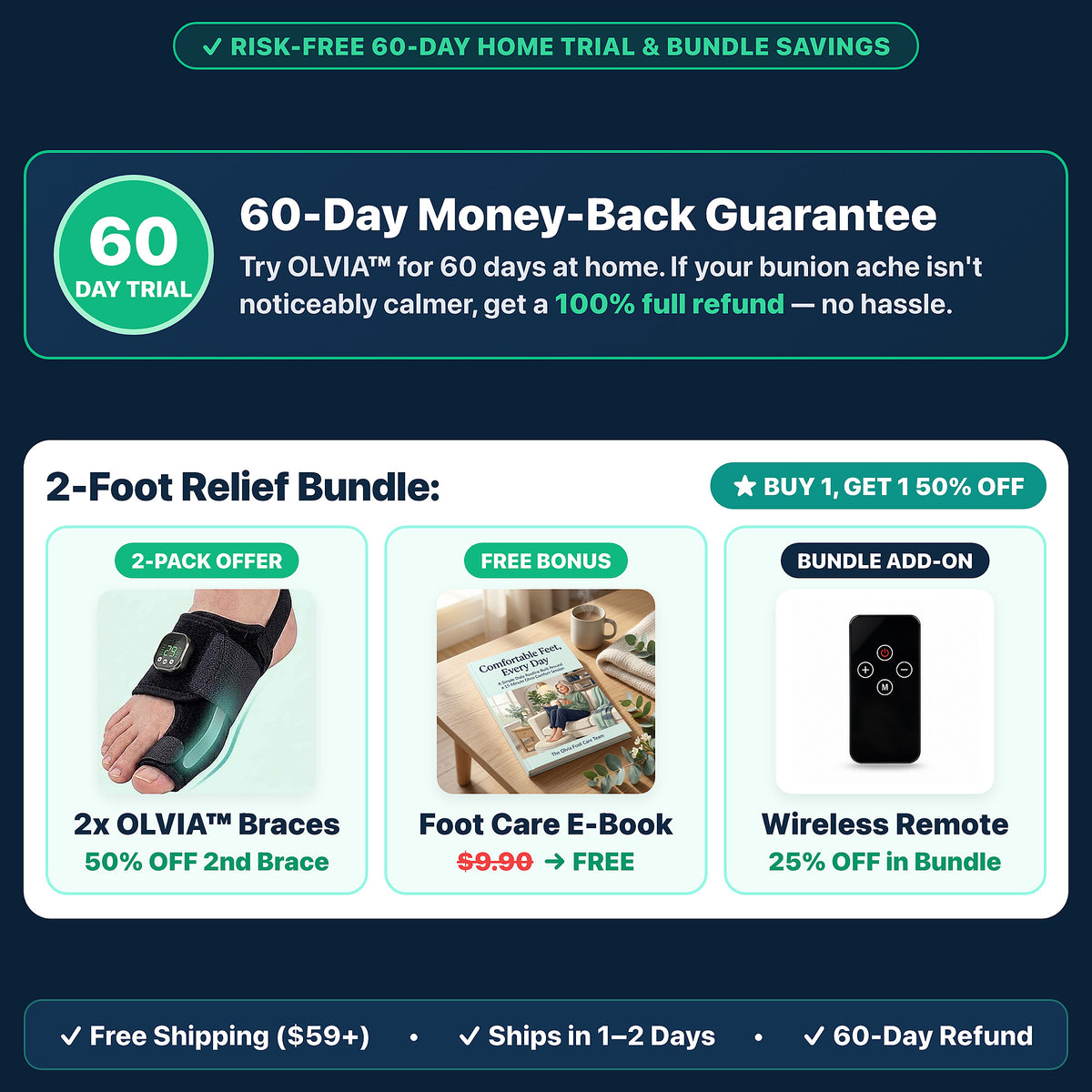
60-Day Money-Back Guarantee
60-Day Money-Back Guarantee
At Olvia, we want you to be completely happy with your purchase. That's why we back every order with a 60-Day Money-Back Guarantee, with a simple, no-forms process.
Shipping & returns
Shipping & returns
Free shipping on all orders of $59 or more
Ships in 1–2 business days · delivery 7–12 business days
Tracking emailed the moment it leaves the warehouse
60-day money-back guarantee. Wear it for the full 60 days. If your bunion pain isn't noticeably easier, email us for a full refund.
Questions: support@tryolvia.com · we reply within 24 hours


Will it fit my foot?
One adjustable device, no size chart to get wrong.


The bump is what you see. The pain is what runs your day.
Years of walking, tight shoes and muscle imbalance slowly pull your big toe out of line. The joint drifts, the bump grows, and every step lands on a raw, inflamed spot.
And it doesn't stop at the bump:
❌ Throbbing pain with every step — worst by the end of the day
❌ A red, swollen joint that's still hot when you're trying to sleep
❌ Stiffness and pressure in every pair of shoes you own
❌ The shoes you love, sitting unworn in the closet
But this is something almost everyone overlooks.
The problem isn't only the bone. It's the muscle along the inside of your foot — the one whose whole job is to pull your big toe away from the others and hold it straight. As the toe drifts, that muscle goes slack, weak, and quiet. It stops doing its job — so the toe keeps sliding.
That's why holding the toe alone was never going to be enough.

An aluminum bar where the others use rubber
The support bar built inside the brace holds your big toe in its natural line for the entire session — steady, precise pressure exactly where the joint needs it.
Soft silicone spacers bend. Gel toe separators squash flat and slide out of place within minutes. Aluminum doesn't give in. It holds the same correct angle from the first minute to the last.
No forcing. No pinching. The strap adjusts to your foot shape, and the heel loop keeps it from sliding — so the correction feels like a firm guide, not a clamp.
Strap it on, sit back on the couch, and let the frame do the work.
🛡️ An aluminum bar where others use rubber. That's the difference you feel in the first minute.

EMS — the half every other bunion product skips
Spacers hold. Splints hold. Toe socks hold. That's where they stop.
And here's the trap: a held toe is not a trained toe. The moment you take a spacer off, the only thing holding your toe is the same weak muscle that let it drift in the first place. Passive support can even let that muscle go quieter still.
OLVIA does the other half.
While the aluminum bar holds your toe in position, EMS microcurrents go to work on the joint itself — boosting circulation right where it hurts, so the redness, the swelling and that deep throbbing ache start to back off.
At the same time, those pulses fire the abductor hallucis — the muscle running along the inside of your foot that's meant to hold your big toe straight. It's a muscle you can't consciously switch on by yourself. The EMS switches it on for you, contraction after contraction, session after session.
It's the same muscle-activation technology physical therapists have used for decades. Here it does double duty: calming the inflamed joint while firing the weakened muscle around it.
You feel a light tingling — never a shock. With 29 intensity levels, you start soft and build up as the muscle gets stronger.
⚡ The bar holds the toe. The EMS wakes up the muscle that's supposed to.

Push surgery years away
Bunionectomy: $4,000–$6,000. Six weeks in a surgical boot. No driving. No long walks. And months before your foot feels like yours again.
Even then, without a stronger muscle holding the joint, some bunions slowly come back. That's not a scare tactic — it's the reason most podiatrists tell you to exhaust the non-invasive route first.
OLVIA is over 10x cheaper. No scalpel. No boot. No time off work. Fifteen minutes on the couch, and you're walking on the same foot the same day.
If it works for you, you've just postponed an operating room — maybe for years.
If it doesn't, send it back within 60 days and pay nothing.
💰 Over 10x cheaper than surgery — no recovery, no risk, no waiting list.

Get your evenings back
Two weeks from now, it's a Tuesday evening. And for the first time in a long while, your feet aren't part of the conversation.
The evening walk — the full loop, not the shortcut home. Grocery runs without mapping out where the benches are. Standing through the whole recipe instead of leaning on the counter halfway. Keeping up with the grandkids instead of watching from the chair.
And the small one that isn't small at all: opening the closet and reaching for the shoes you actually like — not the ones that fit around the pain.
That's not a promise of a miracle. It's just what happens when your feet stop running your schedule.
🌅 Less pain. More evenings. That's the whole point.

One device. Adjusts to your foot.
OLVIA is fully adjustable and designed to fit most adult foot sizes — no measuring, no size chart, no guessing which one to order.
The soft straps let you set the tension to your own foot shape and comfort level, and the heel loop keeps it from sliding mid-session. Whether your bunion is mild or well established, the fit stays secure without pinching.
Getting the fit right, in one line: snug enough that it doesn't shift — never tight enough to throb or go numb. If your toe tingles in a way that isn't the EMS, loosen the toe strap one notch.
🎯 One adjustable fit. No size chart to get wrong.

Built on what clinics already do
When a podiatrist assesses a bunion, two things come up again and again: taking pressure off the joint, and getting the muscles around it working again. Those aren't marketing ideas — they're the standard non-surgical approach.
OLVIA puts both in one device you use at home:
Mechanical alignment — guiding the toe back toward its natural line, so the inflamed joint gets room to settle.
Electrical muscle stimulation — the same class of technology rehabilitation clinics have used for decades to re-activate muscles that have gone weak and quiet, and to improve circulation in the area being worked on.
- No clinic appointment
- No referral, no waiting list
- Just 15 quiet minutes a day from your couch
🎯 Rehab principles. Living-room simplicity.
Why others stop at holding
Spacers, splints and toe socks all do the same one thing: they hold. And holding works — right up until you take it off. That's the gap the EMS fills.Everything else on this list follows from that one difference.
| OLVIA | Spacers & splints | |
|---|---|---|
| Physical alignment support | ||
| Use while relaxing at home | ||
| Rigid bar that holds its angle | ||
| EMS muscle stimulation | ||
| Works on swelling & circulation | ||
| Trains the muscle, not just the toe | ||
| Adjustable intensity (29 levels) | ||
| 15-minute session, then it's off |
F.A.Qs
How long until I notice a difference?
How long until I notice a difference?
Results vary from person to person. Some customers feel more comfortable after the first few sessions; others notice gradual improvement after several weeks of consistent daily use.
Will it get rid of my bunion permanently?
Will it get rid of my bunion permanently?
No — and be skeptical of anything claiming otherwise. A bunion is a change in bone structure, and no wearable device reverses that. OLVIA is designed to support alignment and relieve pain and inflammation so your foot feels and functions better day to day.
How long should I use it each day?
How long should I use it each day?
About 15 minutes per day. Consistency matters more than intensity.
Is it adjustable?
Is it adjustable?
Yes. The adjustable straps fit most adult foot sizes and can be tightened or loosened to your comfort.
What do the numbers on the screen mean?
What do the numbers on the screen mean?
The display shows two things: your current mode (M1–M10) and your intensity level. The "M" button cycles modes; + / − adjust intensity
Why did it turn off by itself?
Why did it turn off by itself?
That's the auto shut-off working. If it doesn't sense skin contact for about 60 seconds, it powers down to save battery. Just put it back on and switch it on again.
Does the EMS hurt?
Does the EMS hurt?
No. It feels like a light tingling. With 29 adjustable levels, you'll find a setting that's pleasant, not shocking
Can I use it on both feet?
Can I use it on both feet?
Absolutely. We offer left-foot, right-foot, and duo-pack options.
Can I wear it while watching TV?
Can I wear it while watching TV?
Yes — it's designed for at-home use while you read, relax, or watch television.
Who should NOT use this?
Who should NOT use this?
Anyone with a pacemaker or implanted electronic device, anyone pregnant, or anyone with open wounds, active infection, or reduced sensation in the feet (including diabetic neuropathy). If you have a diagnosed foot condition, check with your doctor first.
Is there a money-back guarantee?
Is there a money-back guarantee?
Yes — 60 days. If you're not satisfied, contact support within 60 days of delivery for a full refund.
Testimonials
-

★★★★★
Finally something I don't rip off after 10 minutes
I've bought three bunion splints and all three ended up in a drawer because they hurt more than the bunion did. This one I actually look forward to — I put it on during my evening shows and the pulse setting is genuinely relaxing. Three weeks in, the tenderness on the side of my foot is way down. Whether the angle changes long-term I can't say yet, but I'm wearing it, which is more than I can say for the others -

★★★★★
Good, takes a few tries to get the fit right
First two nights I had it too tight and my toe went numb. Loosened the toe strap and it's been fine since. The heel loop keeps it from sliding, which was my main complaint with the cheap ones. Charge lasts about a week for me at 30 min a day. Docking one star only because the instructions are minimal -

★★★★★
On my feet 10 hours a day
I'm a nurse. By hour six my big toe joint is on fire. I use this for half an hour when I get home and it takes the edge off enough that I can sleep. Not a cure, and I'm not pretending it is, but it's the first thing that's given me actual relief without a pill. Bought the pair because both feet are bad. -

★★★★★
Bought it to delay surgery
My podiatrist said surgery eventually. I wanted to try everything first. Six weeks with this and the inflammation is noticeably better — I got through a wedding in real shoes, which hasn't happened in two years. The massage function is the reason I stuck with it. Would recommend to anyone in the "not ready for surgery" camp.


